

When I was a kid in elementary and middle school, my teachers figured out pretty early that I was a very linear thinker. Inductive and deductive reasoning were my great strengths, but creative thinking–not so much. If you asked Kid Me to “draw a building”, you’d get a nice, boxy drawing, very Mondrian and as straight as my hands could make it. You would especially not get an Art Deco masterpiece like the Chrysler building. If you asked Kid Me to draw something variably curvilinear–flowers, people, trees–you’d get a lot of really messy, unpleasantly-shaped stuff that kind of sort of resembled the subject.
I could sing pretty well, so I was a choir kid in elementary and middle school. But my teachers told me quite specifically not to try to branch out and take an art class. That was an option for me in 8th grade, but I had heard more than once that I “couldn’t do art” and that my brain “didn’t work that way,” so I didn’t.
And it stuck. In high school and college, I took on very objective, straightforward stuff–computer science, typing, biology, chemistry. I did take home-making in high school my freshman year, and cooked up a storm, but when we got to the semester of sewing…you can guess, probably. I failed, dismally. I managed to (just barely) pass shorthand, enough to read well-written Gregg shorthand, but never enough to make it terribly useful for me.
Wait. Typing? Shorthand? Yes, I’m old-ish. Those were still taught in my school, by a lovely lady named Mrs. Day. She didn’t ever discourage me, and tried very hard to get my shorthand up to snuff, so I kept at it for a whole year, flogging away at it and hoping I’d figure out the secret to turning sound into squiggly shapes on a piece of paper at speed.
Same through college–I stayed well-clear of art. Every undergrad at my school was required to take either “Music Appreciation,” “Art Appriciation,” or “Film Appreciation”. I took Film, and developed a love for the golden-era MGM Musicals (which were, naturally, our professor’s favorite, also).
There were times I tried to branch out, like the time I posted an “art gallery” in our entry hall, some little drawings of buildings and an attempt at a landscape. I was probably 7 or 8 years old at the time, and my aunt Bernadine bought the landscape; it was just a bit of grass with some simple daisy-like flowers leaning in a breeze. She and Uncle Harry were visiting, and she took the picture down and replaced it with a fifty-cent piece under the Scotch tape I had used to mount it.
The point here, of course, is that the early messages from parents and teachers stuck. Counterexamples stuck, too, but they were less-common, so the message “you can’t do that” stuck harder. Eventually, the internal message from my own soul was “I can’t do that.”
Fast forward half a century, to the days of the COVID plague. I had a thirty-plus year career in IT, a great job as a programmer, and had transitioned into living as the woman I am. My husband and I were traveling around the country living in an RV while I worked remotely. I was watching YouTube on my tablet one evening, and saw the late Bob Ross doing his wet-on-wet paintings come up in my feed. I was looking for something relaxing to watch before bed, so I watched The Joy of Painting for thirty minutes as Ross painted a lovely mountain, with happy little trees between the viewer and the mountain. As he explained his technique, I had the thought: What’s he got that I ain’t got?. As you might expect, this came from a place of mild jealousy–the ability to paint something lovely like that was, in my mind, “something I can’t do.”
But in my meditation time the next day, I thought about that pretty painting, and my response to it. And an inkling of an idea took shape. So I talked to Steven about it. My husband is one of the wisest people I know, in many ways, and when I said I was thinking about getting a kit and trying to make a painting in the Bob Ross style, he had a simple question for me:
“Why don’t ya?”
I stammered and stuttered, and tried to bring up all the reasons why “I can’t do art,” and the more I thought about every response, the more shallow and dated it sounded. I had been told from an early age, and then spent much of the next forty years telling myself that I couldn’t, and that assertion had exactly zero recent support. Carl Sagan wrote, “Extraordinary claims require extraordinary evidence,” and when I started looking at this absolute rule of my life, it started to sound…extraordinary. And also, unsupportable by any sort of evidence.
So, I went on Amazon and bought a kit of paints and brushes that comes with a little booklet that walks you through a pretty simple Ross-styled painting. I went to the nearest hobby store where we were located–a Michael’s–and bought a canvas and a little tabletop easel, and a palette to mix colors on. And a few afternoons after I had all this gear, on a pretty sunny day at a state park in northeast Texas, I sat down at the concrete picnic table, and made…this:
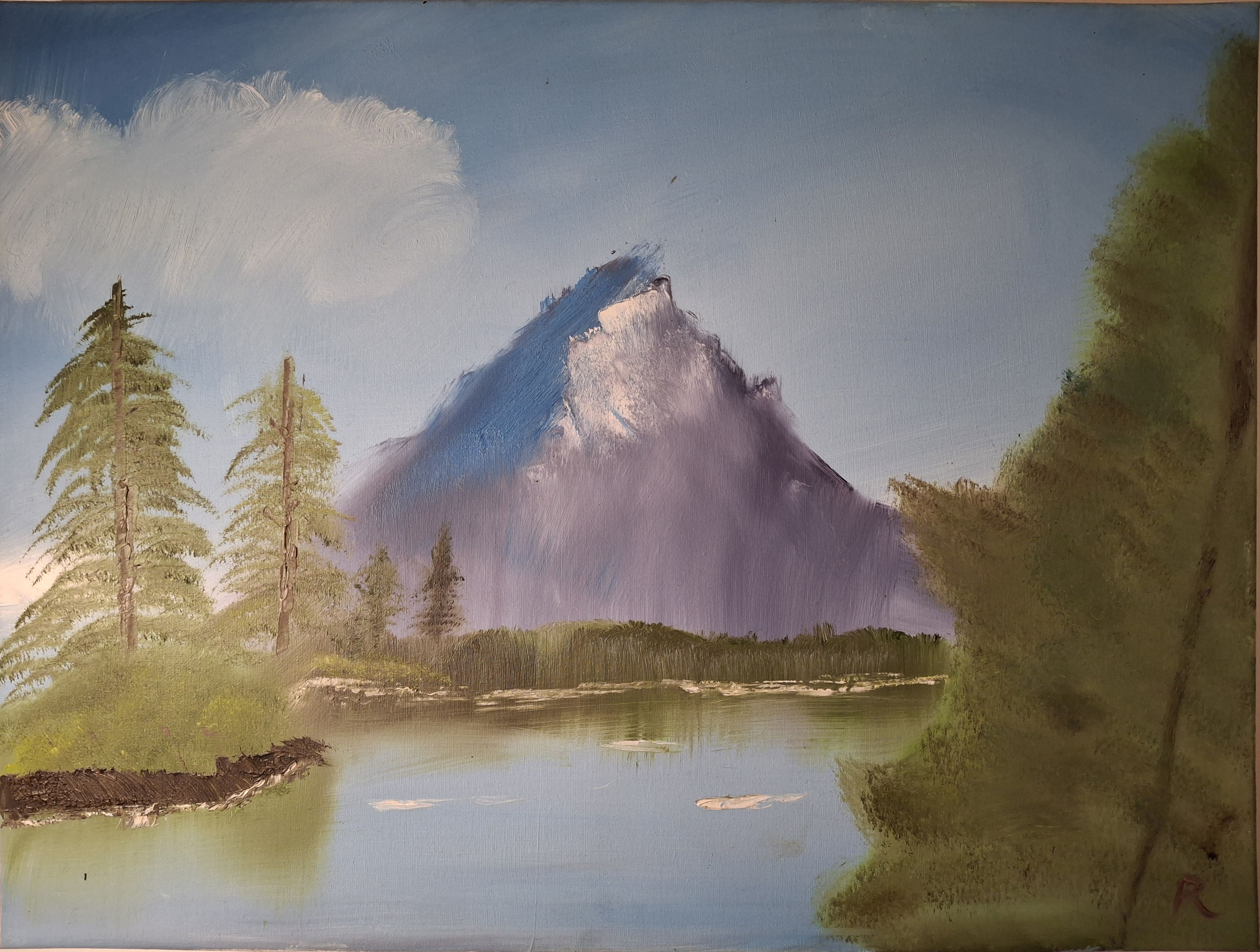
Is it fantastic art, by any objective criteria? No, probably not. I could critique some of the choices I made in this painting all day, and any reputable art critic would likely do the same thing. But is it art? Yes. And did I do it? Also yes. And I realized something, as I watched this dry from across the campsite later that day: I’d been carrying a blatant, unsupported falsehood around as holy writ for decades. This painting now hangs in my office at home, and I’m as proud of it now as I was the day I painted it.
Have you seen Disney’s Encanto? If you haven’t yet, you absolutely should. In the film, one of the three sisters in this extraordinary family has worked hard all her life to live up to everyone else’s constraints on what or whom she should be. In the song, “What Else Can I Do?” Isabela, who has the magical power to cause plants to grow rapidly, has just made a cactus, and opens the song with:
It’s not symmetrical or perfect
But it’s beautiful
And it’s mine
What else can I do?
…and like Isabela, I asked the same question! What else can I do?
I’ve since published my first novella, Matagorda Breeze, under the pen-name Lyla Hopper, which, if you’re interested, you can pick up on Amazon. I’d had bits of this story rattling in my head for years and years, and finally decided to develop it into a book.
I didn’t do that on my own, really. There was a good bit of encouragement from my dear friend and sister-from-another-mister, Hilary, and she directed me to the help of her friend, my editor for that work, Anika Klix at Joy House Publishing.
A few months after my last job ended last year, I asked Steven, “Can I pursue my lifelong dream as a writer and artist?” It was almost like I was asking him for permission, and he jumped on that right off the bat. “Why do you feel the need to ask me for permission?” And I came full-circle, back to that voice that started off as my parents and teachers, and later morphed into my own voice, saying, “you can’t do that.” At the end of the conversation, he asked me again:
“Why don’t ya?”
So, unsurprisingly, there’s a lot more art and writing in the works. I’m as busy – or maybe more so – than I ever was during my nearly-forty years of writing code for a living. I’ll still be writing some code, and hanging out with nerdy people for that, but I’ve got a list of projects as long as my arm on my word processing desk, and on my easel. Look for announcements on some of those springing to life soon. (You can, again if you’re interested, sign up for a newsletter at the bottom of this post!)
Will I ever be a great artist, or a great author? I dunno! But I’m fully-engaged in learning, and growing, and honing my crafts, and getting better every single day to find out!
But that’s not the point, really. There are two things I’d like you to take away from this.
First, If you’re an adult who is contributing to the growth of a child, be it teacher, mentor, coach or parent, don’t teach them that they can’t follow a dream. Don’t decide how their still-developing brain works and will work for the rest of their days; you can’t know that. If you must, figure out how it’s working now, and work with that. But if you hand them the mental baggage of “you can’t do that,” you should count on them carrying that baggage, perhaps for decades, even the rest of their life, even when it no longer fits in their real world.
Lastly, what about you? Are you lugging baggage around, constraints that other people put on you so long ago that you’ve lost track where it started, and think it’s your own soul carrying it? It’s beyond time for you to pull that ugly old thing out from under the bed. “Realize that declarations like ‘You can’t,’ repeated for years, are extraordinary claims by their very nature. Ask yourself for extraordinary, recent evidence, and you’ll probably find out, pretty fast, that you don’t have much, if any.
And that’s the time to change the question, turn it clean on its head and ask, “Why Don’t Ya?”
You might have perfectly valid answers to that question, of course. But throwing that old baggage out of your head, realizing it was never yours in the first place, and giving yourself permission to try, is probably one of the best things you can do for yourself, ever. It’s liberating and refreshing to realize that you don’t have to ask some long-dead teacher’s permission to do something you’ve always wanted to try. Get the facts, and learn what you need to know, and then decide.
And if the result isn’t as grand as you hoped for, or as grand as someone else’s? So what? You did it anyway, and that’s worth something.